Weinreb amide reduction
Abstract
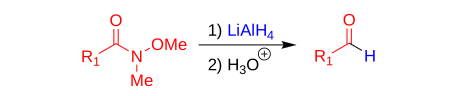
The Weinreb amide reduction is a reaction that converts a Weinreb amide into an aldehyde using a reductant, most commonly LiAlH4 or DIBAL-H. It is one of the most reliable and chemoselective methods for the partial reduction of an amide to an aldehyde without over-reduction to the corresponding amine.
Keywords
Weinreb amide, Reduction, Aldehyde
Category
Amide
Mechanism
Here, LiAlH4 acts as a hydride donor. The first hydride attacks the electrophilic carbonyl carbon, breaking the C bond of C=O and transferring the electron pair to the oxygen atom, which becomes an alkoxide coordinated to the aluminium center. The methoxy group on nitrogen then acts as a second coordinating ligand to the aluminium center, forming a stable five-membered chelate ring that locks the tetrahedral intermediate in place. Unlike standard amide reduction, the chelate ring in the Weinreb amide prevents iminium formation by blocking departure of the nitrogen, and protects the carbon center from further hydride attack. The aldehyde is released only after hydrolysis during acidic aqueous workup.
