Weinreb amide formation
Abstract
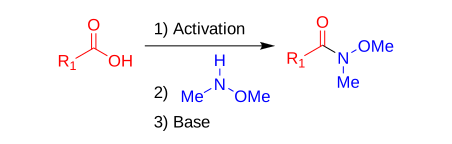
Weinreb amides are synthesized from an activated carboxylic acid derivative by a reaction with the reagent N,O-dimethylhydroxylamine (DMHA). These compounds are widely used in reactions implying organomagnesium (Grignard) reagents, allowing the controlled formation of alkyl-substituted ketones.
Keywords
Carboxylic acid, N,O-diméthylhydroxylamine, Weinreb amide
Category
Carboxylic acid
Mechanism
An initial activation step is required to activate the carboxylic acid, typically through formation of an acyl chloride or an active ester. Then, a nucleophilic addition-elimination is performed by DMHA onto the electrophilic carbonyl carbon of the activated carboxylic acid species, leading to the expulsion of the leaving group to give a protonated ammonium intermediate. The introduction of a base then promotes deprotonation of this ammonium intermediate, generating the Weinreb amide.
This special amide is useful to perform a controlled, single-step conversion into an aldehyde in the presence of lithium aluminium hydride (LiAlH4), thanks to the chelation-stabilized tetrahedral intermediate that prevents over-reduction to the primary alcohol.

Recent review
Balasubramaniam, S.; Aidhen, I. S. The growing synthetic utility of the Weinreb amide. Synthesis. 2008, 2008, 3707-3738.