Carboxylic acid activation - Active ester
Abstract
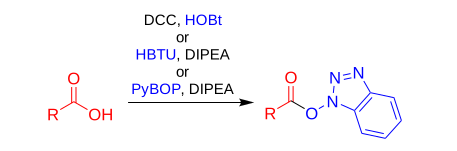
Carboxylic acids are poor electrophiles in their native form due to the resonance delocalization of the carboxylate that reduces the electrophilicity of the carbonyl carbon. Activation consists of converting the -OH into a better leaving group, generating a more reactive acyl electrophile toward nucleophiles (amines, alcohols, organometallics, etc…). Beyond the existing methods to activate a carboxylic acid, one consists in converting it into an active ester, highly reactive toward nucleophilic attack.
Keywords
Carboxylic acid, Activation, Activate ester
Category
Carboxylic acid
Mechanism
Active esters are esters in which the alkoxy leaving group is electron-poor and therefore a better leaving group than a standard alkoxide. Currently, three main families of coupling reagents are used to form active esters: carbodiimides (DCC, DIC, EDC), uroniums (HATU, HBTU, HCTU) and phosphoniums (PyAOP, PyBOP).
1) Carbodiimide activation
First, deprotonation of the carboxylic acid by a nitrogen atom of the carbodiimide generates a carboxylate ion that immediately attacks the electrophilic central carbon of the protonated carbodiimide in a nucleophilic addition. This forms the O-acylisourea intermediate, a highly reactive intermediate. The HOBt immediately attacks the O-acylisourea intermediate, displacing dicyclohexylurea (DCU) and yielding the HOBt active ester.
2) Uronium activation
First, the base (typically, diisopropylethylamine - DIPEA or triethylamine - TEA) deprotonates the carboxylic acid, generating the carboxylate anion. Then, the carboxylate attacks the electrophilic uronium carbon of HBTU, displacing the HOBt anion (OBt-) and forming a highly reactive O-acyluronium intermediate. The OBt- immediately attacks the O-acyluronium, displacing tetramethylurea as leaving group and yielding the HOBt active ester.
3) Phosphonium activation
First, the base (typically, diisopropylethylamine - DIPEA or triethylamine - TEA) deprotonates the carboxylic acid, generating the carboxylate anion. Then, the carboxylate attacks the electrophilic center of PyBOP, displacing the HOBt anion (OBt-) and forming an acyloxyphosphonium intermediate. Exactly as in HBTU mechanism, the OBt- immediately attacks the acyloxyphosphonium, displacing tripyrrolidinophosphine oxide (Py3P=O) and yielding the HOBt active ester.
