Sandmeyer reaction
Abstract
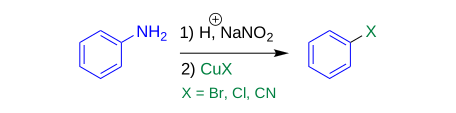
The Sandmeyer reaction is a reaction in which a primary aromatic amine (aniline) is converted into a functionalized aryl (Ar-X, where X = Cl, Br, CN, etc.) through two sequential steps : the formation of a diazonium salt followed by a copper(I)-catalyzed step.
Keywords
Aniline, Sodium nitrite, Aryl halide
Category
Amine
Mechanism
The Sandmeyer reaction is initiated by the formation of an aryldiazonium salt from a primary aromatic amine (Need a refresher? Check the Formation of a diazonium salt sheet). Upon addition of copper(I) salt (CuX where X = Cl, Br, CN, etc.), the reaction proceeds via a single-electron transfer (SET) from Cu(I) to the diazonium cation, generating an aryl diazenyl radical and a copper(II) radical cation species. The latter rapidly combines with the counter-anion to yield the copper(II) radical. The aryl diazenyl radical then undergoes homolytic loss of dinitrogen producing a highly reactive aryl radical. This aryl radical reacts with the copper(II) to form a transient aryl-copper(III) complex. Reductive elimination from this complex regenerates the copper(I) and delivers the desired functionalized aryl.
