Balz-Schiemann reaction
Abstract
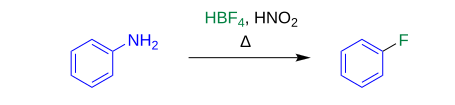
The Balz-Schiemann reaction is a reaction in which an aniline is first converted into a diazonium tetrafluoroborate salt by treatment with nitrous acid followed by the addition of tetrafluoroboric acid (HBF4). Thermal decomposition of this intermediate yields the desired fluoroarene.
Keywords
Aniline, Nitrous acid, Tetrafluoroboric acid, Fluoroarene
Category
Aromatic
Mechanism
The Balz-Schiemann reaction begins with the formation of an aryl diazonium salt by treating aniline with nitrous acid (Need a refresher? Check the Formation of a diazonium salt sheet). Upon thermal decomposition of this salt with loss of a dinitrogen molecule, the tetrafluoroborate ion then acts as a fluoride source, delivering fluorine to the aryl cation. The reaction gives the desired fluoroarene with boron trifluoride as a by-product.
