Ozonolysis of alkyne
Abstract
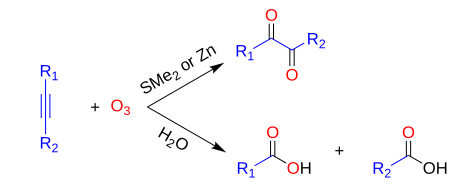
Ozonolysis of alkyne is a reaction between an alkyne and ozone that leads to different products, depending both workup conditions and the substitution pattern of the alkyne. With neutral workup, carboxylic acids or carbon dioxide can be obtained. Under reductive workup, diketone or α-ketoaldehyde can be produced.
Keywords
Alkyne, Ozone, Carboxylic acid, Diketone, α-ketoaldehyde
Category
Alkyne
Mechanism
In a first [3+2] cycloaddition between the alkyne and ozone, a first molozonide-type intermediate (Need a refresher? Check the Ozonolysis of alkene sheet) is formed. This latter is unstable and undergoes retrocycloaddition to yield a zwitterionic intermediate bearing both an oxide carbonyl and a carbonyl function. A final rearrangement leads to an ozonide-type intermediate. At this stage, depending on the workup conditions, different products can be obtained.
Neutral workup: The ozonide intermediate undergoes rearrangement to generate an anhydride. In the presence of water, the anhydride undergoes hydrolysis releasing after equilibrium a pair of carboxylic acids.
Reductive workup: In the presence of dimethyl sulfide (or other reductants such as Zn or phosphine), the ozonide-type intermediate is attacked by one lone pair on the sulfur atom producing a zwitterionic compound. After elimination of DMSO, a 1,2-diketone is finally obtained. Case of terminal alkyne: under neutral workup, carboxylic acid is formed with formic acid which subsequently decomposes in carbon dioxide. Under reductive workup, a α-ketoaldehyde is produced.

Recent review
Wang, Y.; Rodríguez, E. M.; Rentsch, D.; Qiang, Z.; von Gunten, U. Ozone reactions with olefins and alkynes: kinetics, activation energies, and mechanisms. Environ. Sci. Technol. 2025, 59, 4733-4744.