Ozonolysis of alkene
Abstract
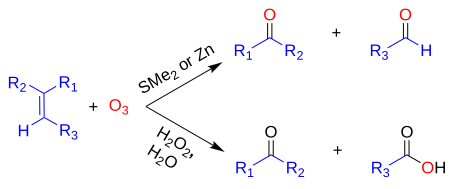
Ozonolysis of alkene is a reaction in which a carbon-carbon double bond is oxidatively cleaved by ozone, leading to two carbonyl products. Depending on the treatment conditions, the products can be ketones, aldehydes or carboxylic acids.
Keywords
Alkene, Ozone, Carboxylic acid, Ketone, Aldehyde
Category
Alkene
Mechanism
The reaction begins with a [3+2] cycloaddition step between the ozone molecule and the alkene, yielding an unstable intermediate called the molozonide. Due to its instability, this intermediate rapidly undergoes a retro-[3+2] cycloaddition, fragmenting into two species: a carbonyl compound (either a ketone or an aldehyde, depending on the nature of substituent R1 or R2) and a carbonyl oxide. These two fragments then recombine through a second [3+2] cycloaddition to form a more stable intermediate called ozonide. At this stage, the nature of the product depends on the workup conditions.
Under a reductive workup using dimethyl sulfide (DME), the lone pair of the sulfur atom performs a nucleophilic attack on one oxygen atom of the weak O-O bond of the ozonide. This step cleaves the peroxide bond, releasing a carbonyl compound (ketone of aldehyde) as the first product along with a zwitterionic intermediate. A final elimination step then produces the target carbonyl compound while DMSO is released as a by-product.
Under an oxidative workup using aqueous hydrogen peroxide and heat, the ozonide first undergoes a retrocycloaddition to generate an aldehyde and an oxide carbonyl. The aldehyde is then oxidized to a carboxylic acid. This transformation proceeds through nucleophilic addition of hydrogen peroxide to the carbonyl carbon, forming hydroperoxide intermediate. This latter undergoes prototropy step and reacts with water in an elimination step to afford the carboxylic acid product. The oxide carbonyl bearing R1 and R2, is attacked by a molecule of water, affording a new intermediate. After a proton transfer step, this latter undergoes rearrangement to regenerate hydrogen peroxide and to form the final ketone.
