Grignard reaction - Weinreb amide reactivity
Abstract
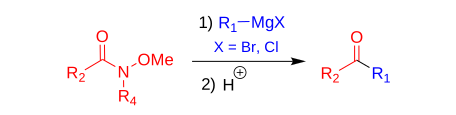
The Grignard reaction is a versatile method for forming new carbon-carbon bonds. It involves a nucleophilic organomagnesium halide reagent, known as Grignard reagent and of a general formula R-MgX where R is an organic group and X is a halogen (either Br or Cl). This reagent reacts with a Weinreb amide to afford a ketone without repeating the Grignard reaction.
Keywords
Weinreb amide, Organomagnesium, Ketone
Category
Amide, Alkane
Mechanism
Weinreb amides are excellent reagents to avoid double addition (as for esters) when the desired product is a ketone or an aldehyde. Indeed, after the first nucleophilic addition of the Grignard reagent, a stable five-membered chelated intermediate is formed through coordination of the magnesium center with both the newly formed alkoxide oxygen and the N-methoxy oxygen of the Weinreb amide. This chelation prevents collapse of the tetrahedral intermediate and therefore blocks release of the ketone in situ, avoiding its exposure to a second equivalent of the Grignard reagent. Upon acidic aqueous workup, the excess Grignard reagent is quenched and the magnesium chelate is destroyed. The nitrogen of the N,O-dimethylhydroxylamine leaving group is protonated under acidic conditions, and the tetrahedral intermediate undergoes elimination to release the amine and the final carbonyl.
