Formation of a diazonium salt
Abstract
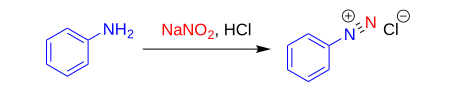
Diazonium salts are versatile intermediates used in several organic reactions such as Sandmeyer reaction or azo compounds synthesis (azobenzene). One of the most common methods for preparing a diazonium salt is the reaction of aniline with sodium nitrite in acidic conditions.
Keywords
Aniline, Aryl diazonium salt
Category
Aromatic
Mechanism
First, the nitrosonium ion, a key intermediate reagent, must be prepared. To do so, sodium nitrite reacts with hydrochloric acid to form nitrous acid. In a strongly acidic medium, the hydroxyl group of nitrous acid is then protonated, generating an intermediate that loses a water molecule to yield the nitrosonium ion. This electrophilic species is subsequently attacked by the amine function of aniline, forming a new N-N bond. The resulting intermediate then undergoes two successive proton transfer steps, followed by the elimination of a water molecule, ultimately affording the diazonium salt.

Recent review
Mo, F.; Dong, G.; Zhang, Y.; Wang, J. Recent applications of arene diazonium salts in organic synthesis. Org. Biomol. Chem. 2013, 11, 1582-1593.