Williamson reaction
Abstract
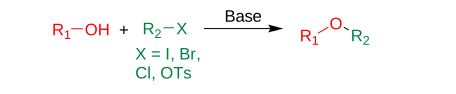
The Williamson reaction allows the synthesis of an ether from an alcohol (R1-OH, where R1 = alkyl or aryl) and an alkyl derivative bearing a good leaving group (R2-X, where X = I, Br, Cl or OTs), under basic conditions.
Keywords
Alcohol, Phenol, Alkyl halide, Ether
Category
Alcohol
Mechanism
The reaction begins with deprotonation of the alcohol. The choice of base depends on the nature of this alcohol: for a simple alkyl alcohol, the pKa is around 16, so a strong base is needed to deprotonate it (sodium hydride, NaH, in our example). This generates an alkoxide ion. For a phenol, the pKa is considerably lower, around 10, because the resulting phenolate ion is stabilized by resonance delocalization of the negative charge into the aromatic ring. Consequently, a milder base such as sodium or potassium hydroxide is sufficient to deprotonate it.
In the second step, the alkoxide (or phenolate) acts as a nucleophile and attacks the alkyl iodide, displacing the iodide ion leaving group and forming the ether product.

Recent review
Mandal, S., Mandal, S.; Ghosh, S. K.; Sar, P.; Ghosh, A.; Saha, R.; Saha, B. A review on the advancement of ether synthesis from organic solvent to water. RSC Adv. 2016, 6, 69605-69614.