Wagner-Meerwein rearrangement
Abstract
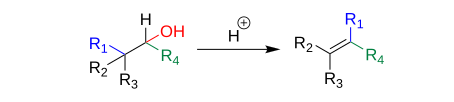
Wagner-Meerwein rearrangement is an acid-catalyzed reaction in which a molecule undergoes dehydration, generating a new alkene. A key feature of this rearrangement is the 1,2-alkyl (or aryl, hydride ...) shift step which leads to a more substituted and stabilized carbocation.
Keywords
Alcohol, Alkene, Elimination, Rearrangement, H-shift, Alkyl-shift, Aryl-shift
Category
Alcohol
Mechanism
The first step corresponds to an elimination, leading to the synthesis of a carbocation species. In our example, this intermediate undergoes a 1,2-alkyl shift step, the nature of which depends on the α-substituted group (hydride, alkyl or aryl migration). This migration step is the driving force of the reaction, as it leads to the formation of a more stable carbocation. Accordingly, the group that migrates preferentially is the best one to stabilize the positive charge in the transition state. After this rearrangement, the new carbocation intermediate undergoes deprotonation, forming the alkene compound and regenerating the acid catalyst.

Recent review
Birladeanu, L. The story of the Wagner-Meerwein rearrangement. J. Chem. Educ. 2000, 77, 858.