Vilsmeier-Haack reaction
Abstract
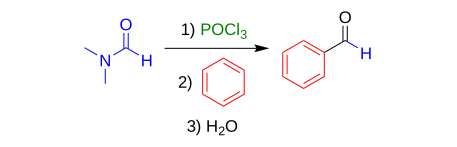
The Vilsmeier–Haack reaction is an electrophilic aromatic formylation that introduces an aldehyde group (–CHO) onto an electron-rich aromatic or heteroaromatic ring, using a combination of DMF and phosphorus oxychloride (POCl3) as formylating agent.
Keywords
Aromatic, Benzaldehyde
Category
Aromatic
Mechanism
First, the carbonyl oxygen of DMF attacks the phosphorus atom of POCl3, displacing a chloride ion and forming an activated intermediate in which the oxygen atom of DMF is a good leaving group. The chloride then attacks the electrophilic carbonyl carbon, leading to departure of the activated oxygen and yielding the chloroiminium ion known as Vilsmeier reagent. Then, the electron-rich arene attacks the electrophilic carbon of the Vilsmeier reagent, forming an arenium ion (EAS fashion). Loss of a proton restores aromaticity, yielding a chloroiminium adduct directly on the ring. Upon aqueous workup, the iminium is hydrolyzed, releasing dimethylamine (HNMe2) and yielding the final aromatic aldehyde. It is important to note that electron-poor arenes (e.g. nitrobenzene) do not react. The ring must be sufficiently nucleophilic to attack the Vilsmeier reagent.

Recent review
Biçer, A. Investigation of Vilsmeier–Haack Formylation Reactions on Substituted 4-Aryl-2-Aminothiazole Derivatives. ChemistrySelect. 2025, 10, e20240602.