Ugi reaction
Abstract
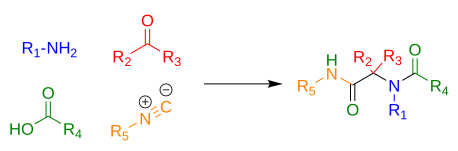
The Ugi reaction is a multicomponent reaction that combines an aldehyde (or a ketone), an amine, a carboxylic acid and an isocyanide to form a bis-amide.
Keywords
Carboxylic Acid, Amine, Isocyanide, Aldehyde, Ketone, Bis-amide
Category
Multicomponent reaction
Mechanism
First, the amine reacts with the aldehyde (or ketone) to form a hemiaminal intermediate. The latter is then converted into an imine after loss of a water molecule. Due to the presence of a carboxylic acid in the reaction medium, the imine is protonated to form the corresponding iminium ion, forming a highly electrophilic carbon. The isocyanide subsequently attacks the electrophilic carbon of the iminium ion to form a nitrilium intermediate. This step is followed by the nucleophilic addition of the carboxylate to the nitrilium carbon. The final step consists in an intramolecular acyl transfer, leading to the formation of the bis-amide product.

Recent review
Fouad, M. A.; Abdel-Hamid, H.; Ayoup, M. S. Two decades of recent advances of Ugi reactions: synthetic and pharmaceutical applications. RSC Adv. 2020, 10, 42644-42681.