Tsuji-Trost coupling
Abstract
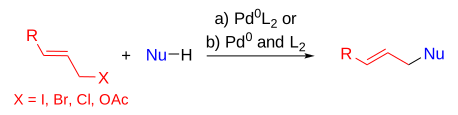
The Tsuji-Trost reaction is a palladium-catalyzed allylic substitution involving an allylic substrate bearing a leaving group (such as halide, acetate…) and a nucleophile (soft or hard), enabling the formation of a new carbon-carbon or carbon-heteroatom bond.
Keywords
Alkene, Allyl, Organometallic
Category
Organometallic catalysis, Alkene
Mechanism
The catalytic cycle begins with the coordination of the allylic substrate (allylic halide, acetate etc) to the palladium(0) complex, forming a η2-alkene-palladium(0) complex (1). Subsequent oxidative addition yields an η3-alkene-palladium(II) intermediate (2). This species can exist in equilibrium with an electrophilic cationic η3-alkene-palladium(II) complex. At this stage, the pathway diverges based on the nucleophile's character:
Soft nucleophiles (pKa < 25, such as malonates or β-ketoesters) directly strikes one of the terminal allylic carbons.
Hard nucelophiles (pKa > 25, such as Grignard reagents) first attacks the palladium center, after what, a reductive elimination is performed to couple the nucleophile to the allylic moiety (3*).
Finally, dissociation of the newly formed allylic product regenerates the active palladium(0) catalyst (4).
