Toluene oxidation with KMnO4
Abstract
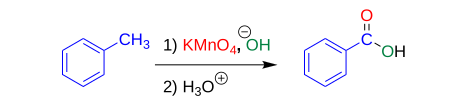
The treatment of toluene derivatives with potassium permanganate under basic conditions leads to the synthesis of benzoic acid derivatives. A strict prerequisite for this reaction is the presence of at least one hydrogen atom attached to the benzylic position.
Keywords
Toluene, Potassium permanganate, Benzoic acid
Category
Aromatic
Mechanism
The reaction initiates via a radical pathway where a hydrogen atom transfer occurs from the toluene methyl group to an oxygen atom of MnO4-. This step generates a resonance-stabilized benzylic radical and a protonated manganate intermediate. Rapidly, a hydroxyl radical transfer takes place, coupling with the benzylic intermediate to afford benzyl alcohol while reducing the manganese species. The benzyl alcohol is then oxidized to benzaldehyde via a subsequent hydride attack toward a manganese center. Under basic conditions, a hydroxide ion acts as a nucleophile, attacking the electrophilic carbonyl carbon of benzaldehyde to form a tetrahedral intermediate. Finally, a last molecule of permanganate facilitates a final hydride abstraction from this intermediate, yielding the benzoate ion. This latter is treated upon acidic workup for collecting the benzoic acid.
