Swern oxidation
Abstract
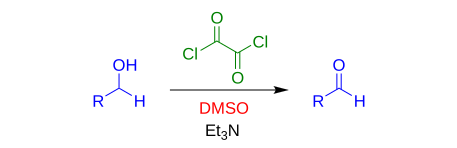
The Swern oxidation is a reaction in which a primary or secondary alcohol is converted into an aldehyde or ketone, respectively, using oxalyl chloride (COCl)2 and dimethylsulfoxide (DMSO) as the oxidizing system, in the presence of a base (typically triethylamine, Et3N).
Keywords
Alcohol, Oxidation, Aldehyde, Ketone
Category
Alcohol
Mechanism
First, the oxygen atom of DMSO attacks one carbonyl carbon of oxalyl chloride, displacing a chloride ion and forming a chlorosulfonium intermediate. This intermediate loses CO2 and CO, generating a chlorodimethylsulfonium ion (Me2S+-Cl-), which is the active oxidizing species. The alcohol attacks the electrophilic sulfur of the chlorodimethylsulfonium ion, displacing chloride and forming an alkoxysulfonium intermediate.The base (Et3N) deprotonates one of the methyl groups of the sulfonium ion, triggering a [1,2]-elimination. The electrons from the C–H bond of the methyl group flow toward the sulfur, simultaneously breaking the O–C bond of the substrate.The elimination yields the carbonyl compound (aldehyde or ketone), dimethylsulfide (Me2S), and triethylammonium salt.
