Strecker reaction
Abstract
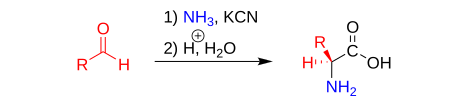
Strecker reaction is a reaction where an aldehyde is condensed in presence of cyanide salt and ammonia in an aqueous acid medium, to give an α-amino acid.
Keywords
Aldehyde, Cyanide salt, Ammonia, α-Amino acid.
Category
Aldehyde/Ketone
Mechanism
The Strecker reaction begins with the protonation of the aldehyde by a Brønsted acid. This electrophilic intermediate is then attacked by ammonia, yielding a protonated hemiaminal. After a proton transfer and elimination of water, an iminium ion is obtained. The cyanide anion subsequently performs a nucleophilic addition on the electrophilic carbon of the iminium ion, giving an α-aminonitrile. The second stage of the mechanism corresponds to the hydrolysis of the nitrile function. Protonation of the nitrile nitrogen by a Bronsted acid generates a nitrilium ion, which is then attacked by a water molecule at the electrophilic carbon. After a proton transfer, the resulting protonated iminol undergoes rearrangement to give a new intermediate. A second water molecule then performs a nucleophilic attack on the carbonyl carbon of this intermediate, forming a tetrahedral intermediate. Collapse of this tetrahedral intermediate leads to the elimination of ammonia and release of the α-amino acid.
