Sonogashira reaction
Abstract
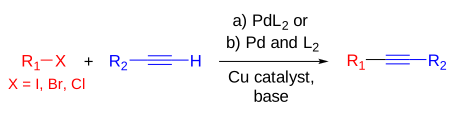
Sonogashira reaction is a palladium-catalyzed cross-coupling reaction between an aryl halide or vinyl halide (R1-X, where X = I, Br or Cl) and a terminal alkyne.
Keywords
Alkyne, Aryl halide, Vinyl halide, Cross coupling
Category
Organometallic catalysis
Mechanism
The catalytic reaction starts with the oxidative addition of the aryl halide (or vinyl halide) to the palladium(0) center (1). In parallel, the terminal alkyne is coordinated to the copper(I) (A) and then deprotonated by a base (typically triethylamine), leading to a copper acetylide intermediate (B). The palladium(II) complex undergoes transmetallation with the copper(I) complex, forming a palladium(II) species bearing both aryl and alkynyl ligands and regenerating the copper(I) catalyst (2). Finally, the reductive elimination leads to the desired product and the palladium(0) catalyst (3).

Recent review
Chinchilla, R.; Najera, C. Recent advances in Sonogashira reactions. Chem. Soc. Rev. 2011, 40, 5084-5121.