Sharpless Epoxidation
Abstract
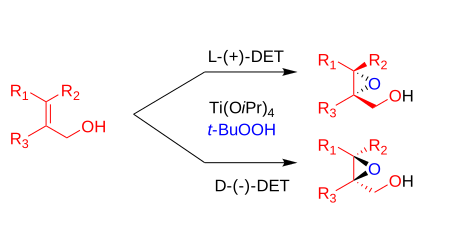
This reaction involves the epoxidation of an allylic alcohol by tert-butyl hydroperoxide, catalysed by a titanium(IV) isopropoxide complex in the presence of a chiral auxiliary, diethyl tartrate (DET).
Keywords
Allylic alcohol, DET, Epoxide
Category
Alcohol, Alkene
Mechanism
The catalytic species is believed to be a dimeric titanium(IV) complex, formed after the exchange of two isopropoxide ligands with two molecules of DET (0). Subsequently, a third isopropoxide ligand is replaced by tert-butyl hydroperoxide (TBHP) (1), generating an alkylperoxo ligand coordinated to the titanium center. Concurrently, the fourth isopropoxide ligand is exchanged with allylic alcohol substrate (2). The alkylperoxo ligand acts as a bidentate ligand, with its terminal oxygen atom coordinating to the titanium center to complete the octahedral coordination sphere.
At this stage, the tartrate backbone occupies the equatorial plane of the complex (the purple plane), while the coordinated alkene and the bidentate alkylperoxo ligand lie in the axial plane, perpendicular to the equatorial plane (the green plane). This geometry is critical: it places the reactive peroxide oxygen atom and the alkene 𝜋-system in a cofacial arrangement that is ideally set up for intramolecular oxygen transfer.
The enantioselectivity of the reaction arises from the chiral DET backbone, which generates an asymmetric steric environment within the active site. In the case of L-(+)-DET, the two stereocenters of the DET, now engaged as CH(O-Ti), adopt a well-defined conformation in which the DET backbone and its substituents crowd the bottom face of the coordinated alkene. This leaves the top face accessible to the incoming electrophilic oxygen atom of the peroxo ligand (3). Consequently, with L-(+)-DET, epoxidation occurs selectively from the top face. With D-(-)-DET, the mirror-image epoxidation is performed.
It should be noted that this facial selectivity is conventionally described using the Sharpless mnemonic: when the allylic alcohol is drawn in standard orientation with the C-OH group at the bottom right and the carbon chain extending to the left, L-(+)-DET delivers oxygen atom from the top and D-(-)-DET from the bottom.
Finally, a ligand exchange releases the enantioenriched epoxide (4) along with the tert-butanol and reintroduction of two isopropoxide ligands regenerates the active titanium catalyst.

Recent review
Sartori, S. K.; Miranda, I. L.; Diaz, M. A.; Diaz-Muñoz, G. Sharpless asymmetric epoxidation: Applications in the synthesis of bioactive natural products. Mini-Rev. Org. Chem. 2021, 18, 606-620.