Sharpless alkene dihydroxylation
Abstract
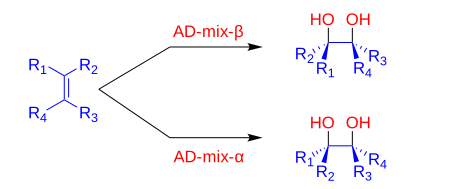
The Sharpless alkene dihydroxylation is a reaction in which an alkene is converted into a vicinal diol with high enantiomeric excess, using a pre-formulated mixture known as AD-mix. This mixture contains four components: osmium(VIII) tetroxide (OsO4) as catalyst, a chiral alkaloid ligand, potassium ferricyanide (K3Fe(CN)6) as a stoichiometric co-oxidant and potassium carbonate as a base to maintain slightly basic conditions.
Keywords
Alkene, Osmium tetroxide, DHQ, DHDQ, Diol
Category
Alkene
Mechanism
The catalytic cycle begins with the coordination of the chiral ligand (L*), such as dihydroquinine (DHQ), dihydroquinidine (DHQD) or their bis-phthalazine adducts (DHQ2PHAL or (DHQD)2PHAL) to OsO4, generating the active chiral osnium(VIII) complex (0). The complex undergoes a concerted [3+2] cycloaddition step, forming a five-membered cyclic osmium(VI) glycolate ester (osmate ester) intermediate (1). Basic hydrolysis of this osmate ester liberates the vicinal diol product with high enantiomeric excess, along with the reduced osmium(VI) species and the free chiral ligand (2). The osmium(VI) complex is subsequently re-oxidized to osnium(VIII) by a stoichiometric co-oxidant, typically potassium ferricyanide (or N-methylmorpholine N-oxide, NMO) (3). Finally, coordination of the chiral ligand and dissociation of two hydroxide ligands closes the catalytic cycle and restores the active chiral complex (4).
Origin of enantioselectivity: The stereochemical outcome of the reaction is rationalized through the transition state model presented by Corey, based on the concept of a U-shaped chiral binding pocket. This architecture creates a highly asymmetric environment around the metal: one face of the pocket is sterically open, while the other is shielded by the alkaloid substituent. In our example, the U-shape is represented with one (DHQ)2PHAL enantiomer.
