Schotten-Baumann reaction
Abstract
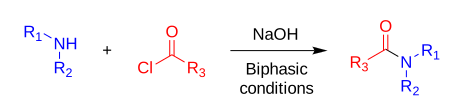
The Schotten-Baumann reaction is a synthetic method for the preparation of amides from a secondary or primary amine and an acyl chloride, carried out in a biphasic basic aqueous medium.
Keywords
Amine, Acyl chloride, Amide
Category
Amine
Mechanism
The first step consists of nucleophilic addition of the amine onto the electrophilic carbonyl carbon of the acyl chloride, forming a tetrahedral intermediate. Collapse of this latter restores the carbonyl and drives the departure of the chloride leaving group, affording an N-protonated amide. Finally, the base catches the proton released in this step, preventing the generation of hydrochloric acid in the reaction medium.
