Pauson-Khand reaction
Abstract
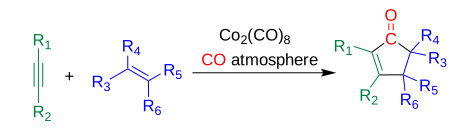
The Pauson-Khand coupling is a formal [2+2+1] cycloaddition involving a binuclear cobalt complex, an alkyne, an alkene and carbon monoxide to synthesize an α,β-unsaturated cyclopentanone.
Keywords
Alkene, Alkyne, Carbon monoxide, Cyclopentanone
Category
Alkene, Alkyne
Mechanism
The Pauson-Khand coupling begins with the dissociation of two CO ligands, after which the alkyne approaches the binuclear complex and undergoes coordination (1). The alkyne bridges the two cobalt atoms, each carbon interacting with both cobalt centers. The alkyne donates 𝜋-electrons density into empty cobalts orbitals while receiving 𝜋-backdonation, without any formal change in cobalt oxidation state, both remain Co(0). Loss of one additional carbon monoxide ligand generates a 16-electron complex (2), followed by the coordination of the alkene to one cobalt center (3). This is a stereodefining step: the facial selectivity arises from steric interactions between the substituents on the alkene (R3, R4, R5 and R6) and those on the alkyne-cobalt framework (R1 and R2), with the less hindered face of the alkene approaching the metal. Insertion of the alkene into the Co-C bond forms a new five-membered metallacyclopentene (4). Two new Co-C σ bonds form on the cobalt atom bearing the alkene, oxidizing that single cobalt center to Co(II), while the second cobalt remains Co(0). A subsequent intramolecular CO migratory insertion incorporates the carbonyl carbon into the growing carbon framework, forming a six-membered acylcobalt intermediate, after what a carbon monoxide unit is coordinated (5). Finally, reductive elimination of this Co(II) metallacycle releases a bicyclic intermediate (6). This latter undergoes dissociation to deliver the α,β-unsaturated cyclopentanone product. Addition of two carbon monoxide units restarts the catalytic cycle (7).

Recent review
Yang, Z. Navigating the Pauson–Khand reaction in total syntheses of complex natural products. Acc. Chem. Res. 2021, 54, 556-568.