Oxidative cleavage of diol with NaIO4
Abstract
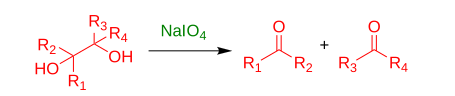
First, the lone pair of one hydroxyl group attacks firstly the iodine atom of periodate to form an iodinate ester intermediate. After proton transfer, the second hydroxyl group undergoes the same reaction, closing the five-membered cyclic ester. The cyclic intermediate then undergoes cycloreversion, in which the C-C bond is cleaved heterolytically, yielding two carbonyl compounds and releasing iodate with water.
Keywords
Alcohol, Sodium periodate, Aldehyde, Ketone
Category
Alcohol
Mechanism
First, the lone pair of one hydroxyl group attacks firstly the iodine atom of periodate to form an iodinate ester intermediate. After proton transfer, the second hydroxyl group undergoes the same reaction, closing the five-membered cyclic ester. The cyclic intermediate then undergoes cycloreversion, in which the C-C bond is cleaved homolytically, yielding two carbonyl compounds and releasing iodate with water.
