Oxidative cleavage of alkyne with KMnO4
Abstract
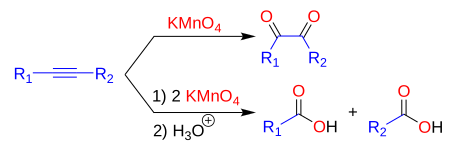
The oxidative cleavage of alkynes using potassium permanganate (KMnO4) is a reaction during which an alkyne is oxidized by KMnO4 to afford, depending on the reaction medium, either an α-diketone or a carboxylic acid as the desired product.
Keywords
Alkyne, Potassium permanganate, Diketone, Carboxylic acid
Category
Alkyne
Mechanism
The reaction is perfomed in organic solvent, in the presence of a phase-transfer reagent with KMnO4. This latter undergoes [3+2] cycloaddition with the alkyne, forming a five-membered cyclic manganate ester intermediate. Retro [3+2] addition affords a diketone product, with MnO2- as a by-product.
At this stage, hot concentrated KMnO4 is introduced in an aqueous acidic medium (using Brønsted acid such as sulfuric acid). The permanganate then performs a nucleophilic attack on an electrophilic carbon atom from a carbonyl. The intermediate obtained undergoes cyclization to give a new highly charged cyclic permanganate ester. The aqueous acidic conditions are essential here to stabilize this species. Finally, retro [3+2] cycloaddition and protonation afford two carboxylic acid products and MnO2+ as by-product.
