Nucleophilic substitution
Abstract
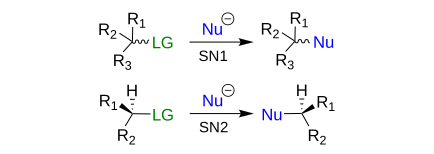
A nucleophilic substitution is a reaction in which a nucleophile displaces a leaving group (LG) attached to a sp3 carbon. Two nucleophilic substitution mechanisms exist, SN1 and SN2, differing in whether bond-breaking and bond-forming occur simultaneously or sequentially.
Keywords
SN1, SN2
Category
Alkane, Alcohol
Mechanism
The SN1 mechanism occurs in two distinct steps. First, the C-LG bond breaks heterolytically, releasing the LG and forming a carbocation. This step is rate-determining. The nucleophilic then attacks the carbocation from either face, resulting in the formation of a racemic mixture. It is important to note that more substituted carbon better stabilize the positive charge of the carbocation, favoring the SN1 mechanism for tertiary substrates and some secondary substrates. Kinetically, SN1 is a first-order mechanism, meaning that the rate depends only on the substrate concentration. The nucleophile does not appear in the rate law because it reacts only after the slow ionization step. The use of polar protic solvents (e.g., H2O and alcohols) stabilizes both the forming carbocation and the departing LG through solvation. Since the nucleophile is not involved in the rate-determining step, strong nucleophiles are not required. It is important to keep in mind that carbocation intermediates are prone to rearrangement and elimination reactions, potentially leading to by-product formation.
The SN2 mechanism occurs in a single concerted step. The nucleophile attacks the electrophilic carbon from the backside of the LG, leading to its simultaneous departure. The transition state is pentacoordinate-like, with partial bonds to both nucleophile and the LG (bond-breaking and bond forming occur simultaneously). Due to the backside attack of the nucleophile, the spatial arrangement of the carbon is flipped, resulting in complete inversion of configuration, also known as Walden inversion. It is important to note that steric hindrance around the carbon impedes backside approach, limiting the SN2 mechanism to primary substrates and some secondary substrates. Kinetically, SN2 is a second-order mechanism, meaning that the rate depends on both reactant concentrations. The use of polar aprotic solvents (e.g., DMSO, DMF and acetone) promotes the SN2 mechanism because these solvents solvate the cation of the nucleophile’s salt without hydrogen-bonding to the nucleophile itself, thereby maintaining it highly reactive. Strong nucleophiles are generally preferred for SN2 reactions to facilitate efficient attack on the electrophilic carbon. It is important to keep in mind that strong nucleophiles are also strong bases that may promote competing E2 elimination reactions, particularly with secondary substrates.
