Nucleophilic aromatic substitution
Abstract
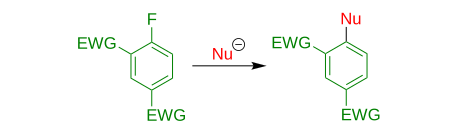
Nucleophilic aromatic substitution (NAS) is a reaction in which a nucleophile replaces a leaving group on an aromatic ring. Unlike nucleophilic substitution at aliphatic carbon atoms, aromatic systems do not generally undergo direct SN2 displacement because the carbon bearing the leaving group is part of a planar sp2-hybridized system. Instead, the reaction proceeds through an addition–elimination mechanism.
Keywords
Aromatic, Nucleophilic substitution
Category
Aromatic
Mechanism
First, the nucleophile attacks the electrophilic carbon bearing the leaving group, forming a non-aromatic intermediate. This (rate-determining) step is facilitated by the presence of one or more electron-withdrawing groups (e.g., nitro, cyano, carbonyl) located in ortho and/or para position to the leaving group, which stabilize the negative charge developed in the intermediate through resonance. The intermediate then undergoes elimination of the leaving group, restoring aromaticity and yielding the substitution product. It is important to note that the leaving-group ability in NAS generally follows the order F > Cl > Br > I, which is opposite to that observed in aliphatic nucleophilic substitutions. This trend arises because the highly electronegative fluorine atom strongly activates the aromatic ring toward nucleophilic attack by increasing the electrophilicity of the carbon atom to which it is attached.
