Nozaki-Hiyama-Kishi reaction
Abstract
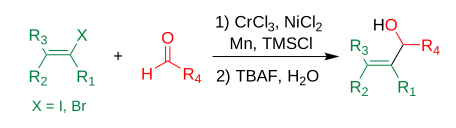
The Nozaki-Hiyama-Kishi reaction is a nickel catalyzed reaction in which a vinyl halide (RX, where X = I or Br) couples with an aldehyde, in the presence of an excess of chromium(II) dichloride, to afford an allylic alcohol.
Keywords
Alkene, Aldehyde, Chrome, Allylic alcohol
Category
Alkene, Aldehyde/Ketone, Organometallic catalysis
Mechanism
The reaction starts with two equivalents of chromium(II) dichloride which reduce nickel(II) dihalide to nickel(0), releasing two molecules of chromium(III) trihalide in the process (1). The nickel(0) complex undergoes oxidative addition into the vinyl halide bond generating a vinyl-Ni(II) species (2). A transmetalation step then occurs with chromium(III), regenerating nickel(II) and producing the organochromium(III) intermediate bearing the vinyl ligand (3). This vinylchromium(III) species subsequently coordinates to the aldehyde carbonyl and undergoes a nucleophilic addition to the C=O bond, yielding a chromium(III) alkoxide intermediate (4). The catalytic cycle is closed by trapping this alkoxide with TMSCl in a chloro-demetalation step, regenerating the chromium(III) trichloride species and releasing the TMS-protected allylic alcohol (5). Finally, treatment with tetrabutylammonium fluoride (TBAF) induces desylation of the silyl ether, affording the desired allylic alcohol.

Recent review
Tian, Q.; Zhang, G. Recent advances in the asymmetric Nozaki–Hiyama–Kishi reaction. Synth. 2016, 48, 4038-4049.