Nitrile hydrolysis
Abstract
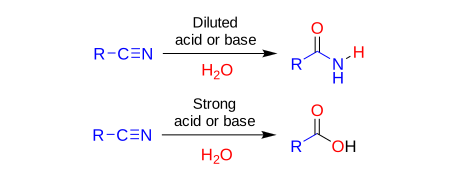
Nitrile hydrolysis consists in the reaction of a nitrile (R–C≡N) with water under acidic or basic conditions, leading sequentially to an amide and then to a carboxylic acid. It is one of the most fundamental methods for converting a nitrile into a carboxylic acid or amide, and can be stopped at either stage depending on conditions.
Keywords
Nitrile, Hydrolysis, Carboxylic acid
Category
Nitrile
Mechanism
First, under acidic conditions, the nitrogen atom of the nitrile is protonated and gives a highly electrophilic nitrilium ion. Water then acts as a nucleophile and attacks the electrophilic carbon, forming an iminol. Tautomerization of the iminol leads to the more stable amide. Use of diluted acid stops the reaction at the amide. If a strong acid is used, the carbonyl oxygen of the amide is protonated, activating the carbonyl toward nucleophilic attack. Then, water attacks the carbonyl carbon, forming a tetrahedral intermediate. After prototropy, the elimination of ammonia (NH3) yields the carboxylic acid.
Under basic conditions, the hydroxide ion acts directly as a nucleophile and attacks the electrophilic carbon of the nitrile, forming an anionic tetrahedral intermediate. Then, protonation of the intermediate gives the corresponding iminol. Tautomerization yields the amide. Use of diluted base stops the reaction at the amide. If a strong base is used, the hydroxide attacks the carbonyl carbon, forming a tetrahedral intermediate. Then, elimination of NH2- gives the carboxylic acid, directly deprotonated by the amide ion. Subsequent acidic workup yields the corresponding carboxylic acid.
