Murai coupling
Abstract
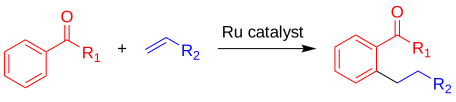
The Murai coupling is a directed C-H activation reaction in which a carbonyl group bore by an aryl compound acts as a directing group to coordinate a ruthenium catalyst and facilitate selective ortho C-H functionalization, enabling the alkylation of aromatic substrate with an alkene.
Keywords
Ketone, Alkene, C-C bond formation, Catalysis
Category
Aldehyde/Ketone, Organometallic catalysis
Mechanism
The starting catalyst Ru0(CO)2(PPh3)3, loses one CO and PPh3 ligand to give the 14-electron active species Ru0(CO)(PPh3)2 (0). In the first step, the substrate coordinates through its carbonyl oxygen atom to the metal center via a directed coordination interaction, bringing the ruthenium into proximity with the ortho C-H bond (1). The second step corresponds to a pre-oxidative addition, in which the ortho C-H bond of the intermediate interacts with the metal center in a five-membered ruthenacycle with an agostic interaction between the ruthenium and the C-H bond (2). This intermediate undergoes oxidative addition of the C-H bond to give RuII complexes (3). Subsequently, dissociation of a ligand and coordination of the alkene affords a RuII 𝜋-alkene complex (4). Migratory insertion of the alkene into the Ru-H bond gives a new intermediate (5). This latter undergoes reductive elimination which forges the new C-C bond and delivers the desired ortho-alkylated product (6). The active catalyst is regenerated by coordination of the dissociated ligand.
