Mizoroki-Heck reaction
Abstract
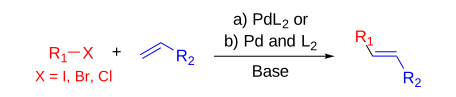
The Mizoroki-Heck coupling engages an aryl or vinyl halide (R1-X, where X = I, Br or Cl) and an activated alkene in a palladium-catalyzed reaction, in the presence of a base.
Keywords
Aryl halide, Vinyl halide, Palladium, Organometallic, Catalysis
Category
Organometallic catalysis
Mechanism
The Mizoroki-Heck coupling begins with an oxidative addition step, in which the aryl halide (or vinyl halide) reacts with a Pd(0) catalyst to form a Pd(II)-aryl complex (1). Next, the vinyl derivative coordinates to the palladium center (2) and a 1,2-migratory insertion of the alkene allows the formation of an alkylpalladium (II) intermediate (3). This intermediate undergoes a fast β-hydride elimination to form the substituted alkene product coordinated to a Pd(II)-hybride species (4). After the dissociation of the alkene (5), a last step of base-assisted reductive elimination gives the product and affords the regeneration of the catalyst Pd(0) (6).
Regioselectivity: Under classic conditions, (aryl or vinyl halide and electron-poor alkene as starting materials, phosphines as ligands) the linear product is the major product. Since the mechasnim proceeds through a neutral Pd(II) intermediate where steric factors control the migratory insertion step.
Under specific conditions favoring a cationic Pd(II) pathway, (such as aryl or vinyl triflates, didentate ligands, ionic liquids etc) electronic effects dominate over steric ones, and the branched product can become the major product.
Stereoselectivity: Under the same classic conditions, before the β-hydride elimination, the bulky groups are preferentially placed anti to each other, leading to the (E)-configured alkene as major product.

Recent review
Oestreich, M. Ed. The Mizoroki–Heck Reaction; John Wiley & Sons, Ltd: Chichester, U.K., 2009.