Mitsunobu reaction
Abstract
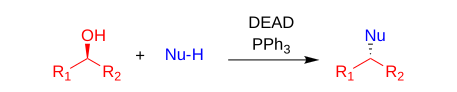
The Mitsunobu reaction consists in the conversion of primary or secondary alcohols into another nucleophilic functional group with inversion of the stereochemistry.
Keywords
Alcohol, Nucleophilic substitution
Category
Alcohol
Mechanism
First, triphenylphosphine (PPh3) attacks the diethyl azodicarboxylate (DEAD) to form a phosphonium intermediate and a hydrazide anion. The latter acts as a strong base and deprotonates the nucleophile (NuH), generating a strong nucleophilic species (Nu-). Then, the oxygen atom of the alcohol attacks the phosphonium intermediate to form an alkoxyphosphonium ion, which is a good leaving group. Finally, the nucleophile (Nu-) attacks the carbon atom in α position relative to the oxygen atom via an SN2 mechanism, resulting in the formation of the substituted product with inversion of stereochemistry (Walden inversion).

Recent review
But, T. Y. S.; Toy, P. H. The Mitsunobu Reaction: Origin, Mechanism, Improvements, and Applications. Chem. Asian J. 2007, 2, 1340-1355.