Michael addition
Abstract
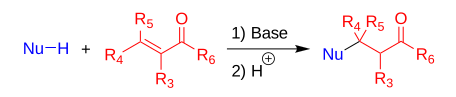
The Michael addition is a reaction involving, on one hand, soft nucleophiles according to the Hard and Soft Acids and Bases (HSAB) principle, known as Michael donors. Typically, Michael donors are stabilized carbanions such as enolate compounds (malonates, β-ketoesters), or soft nucleophiles such as thiols, etc. On the other hand, Michael acceptors are soft electrophiles bearing an electron-withdrawing group conjugated to a C=C double bond, like α,β-unsaturated carbonyl compounds (ketones, aldehydes, esters, etc.).
Keywords
Nucleophilic 1,4-addition, C-C bond formation
Category
Aldehyde/Ketone
Mechanism
For this explanation, 1,3-diketone has been chosen as the Michael donor and an α-β-unsaturated aldehyde as the Michael acceptor. In the presence of a base, the α-hydrogen of the donor is deprotonated, generating a stabilized carbanion (enolate). The resonance delocalization of the negative charge between the two carbonyl groups accounts for the particular acidity of this position. This nucleophilic species then attacks the β-carbon of the acceptor in a 1,4-conjugate addition, forming a new enolate intermediate. Upon aqueous acidic workup, protonation restores the carbonyl function, affording the final Michael product.

Recent review
Huang, G.; Li, X. Applications of Michael addition reaction in organic synthesis. Curr. Org. Synth. 2017, 14, 568-571.