Mannich reaction
Abstract
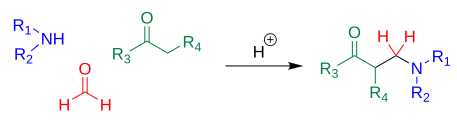
The Mannich reaction is a multicomponent reaction that combines an aldehyde or a ketone, formaldehyde and a secondary amine to form a β-aminoketone, also called Mannich base.
Keywords
Multicomponent Reaction, Amine, Formaldehyde, Aldehyde, Ketone, β-aminoketone
Category
Multicomponent reaction
Mechanism
First, the secondary amine reacts with the formaldehyde to form a hemiaminal intermediate. The latter is then converted into an iminium after loss of a water molecule. This reaction is catalyzed by addition of acid in the reaction medium, such as hydrochloric acid or acetic acid. Then, the aldehyde or ketone undergoes enolization, leading to the formation of a nucleophilic carbon at the α position of the carbonyl. Subsequent nucleophilic addition of the enol on the electrophilic carbon of the iminium generates the Mannich base after deprotonation of the carbonyl.

Recent review
Raju, S. K.; Kumar, V. S.; Reddy, P. V. G.; Reddy, C. S. Synthetic Applications of Biologically Important Mannich Bases: An Updated Review. Open Access Res. J. Biol. Pharm. 2023, 7, 1-15.