Kolbe reaction
Abstract
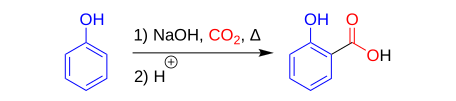
The Kolbe reaction is a reaction in which a phenol is first converted into its phenoxide salt by treatment with a base, then reacts with pressurized carbon dioxide at elevated temperature, to give salicylic acid as the final product.
Keywords
Phenol, Carbon dioxide, Salicylic acid.
Category
Alcohol
Mechanism
The Kolbe reaction begins with the deprotonation of phenol by sodium hydroxide, generating a phenoxide ion. This enolate ion is stabilized by resonance and can be depicted by two resonance structures. Under pressurized CO2 and heat, the phenoxide ion performs a nucleophilic attack on the electrophilic carbon of the carbon dioxide. After re-aromatization and protonation of the carboxylate under acidic workup, the final product, salicylic acid is afforded.
