Knorr pyrazole synthesis
Abstract
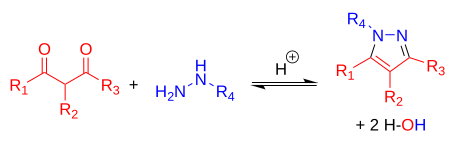
The Knorr pyrazole synthesis is a reaction that yields a pyrazole ring by condensation of a 1,3-dicarbonyl compound (β-ketoester, β-diketone or malonaldehyde derivatives) with a hydrazine (R–NH–NH2), forming a five-membered aromatic nitrogen heterocycle.
Keywords
1,3-dicarbonyl compound, hydrazine, pyrazole
Category
Hydrazine/Hydrazide, Aldehyde/Ketone
Mechanism
First, the amino group of the hydrazine attacks one of the carbonyl carbons of the 1,3-dicarbonyl compound in a nucleophilic addition-elimination sequence, releasing water and forming a protonated hydrazone intermediate. Then, after proton transfer, the second amino group attacks the remaining carbonyl, giving a five-membered ring with expelling of a second molecule of water. Finally, the intermediate undergoes aromatization by proton transfer, yielding the corresponding pyrazole.
