Julia-Kocienski olefination
Abstract
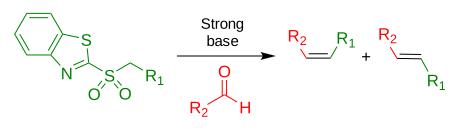
The Julia-Kocienscki olefination is a reaction that converts a heteroaryl sulfone (benzothiazolyl sulfone or 1-phenyl-1H-tetrazolyl sulfone) and an aldehyde (or ketone) into an alkene. It is one of the most powerful methods for selective alkene synthesis.
Keywords
Alkane, Aldehyde/Ketone, Alkene
Category
Alkane, Aldehyde/Ketone
Mechanism
First, deprotonation of the heteroaryl sulfone (here, the benzothiazolyl sulfone) by a strong base (typically, lithium diisopropylamide) gives the α-sulfonyl carbanion. Then, the carbanion adds to the aldehyde carbonyl, forming a β-alkoxide intermediate. The β-alkoxide subsequently undergoes an intramolecular Smiles rearrangement: the alkoxide oxygen attacks the heteroaryl ring, displacing the sulfonyl group and forming a cyclic sulfonate intermediate. Finally, the cyclic sulfonate undergoes spontaneous β-elimination with loss of SO2 and the heteroaryl anion, yielding the alkene. The E/Z-selectivity can be controlled by varying the sulfonyl group, solvent and base.
