Jones oxidation
Abstract
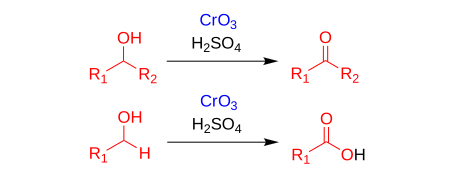
The Jones oxidation is a chromium(VI)-based oxidation reaction used to convert primary alcohols into carboxylic acids and secondary alcohols into ketones using Jones reagent, which is prepared from chromium trioxide (CrO3) and sulfuric acid in aqueous acetone.
Keywords
Alcohol, Oxidation, Ketone, Carboxylic acid
Category
Alcohol
Mechanism
Mechanistically, the alcohol oxygen attacks the electrophilic chromium(VI) center of chromic acid, generated in situ from CrO3 and H2SO4, to form a chromate ester. Water then deprotonates the carbon in ɑ position relative to the oxygen atom of the intermediate, leading to the formation of the carbonyl compound and reduced chromium(IV). For primary alcohols, the aldehyde formed at this step is rapidly hydrated to give a geminal diol. This intermediate can form a second chromate ester and undergo a further oxidation, ultimately yielding the corresponding carboxylic acid. As a result, Jones oxidation generally does not stop at the aldehyde stage. The reaction is highly efficient and broadly applicable; however, the use of toxic chromium(VI) reagents and the generation of chromium waste have led to the development of more environmentally benign oxidation methods.
