Horner-Wadsworth-Emmons reaction
Abstract
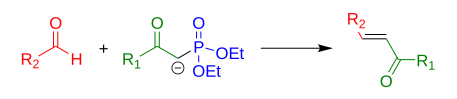
The HWE reaction is a phosphonate-based olefination of aldehydes and ketones, closely related to the Wittig reaction but using a stabilized phosphonate carbanion instead of a phosphorus ylide. It is one of the most widely used methods for the stereoselective synthesis of (E)-alkenes.
Keywords
Aldehyde, Ketone, Phosphonate carbanion, C-C bond formation, (E)-alkene.
Category
Aldehyde/Ketone
Mechanism
The phosphonate reagent is prepared by nucleophilic substitution of a phosphite bearing the desired substituent on an alkyl halide (known as the Arbuzov reaction). Deprotonation of the α-carbon with a strong base (typically, BuLi or NaH) gives the stabilized phosphonate carbanion.
The HWE reaction consists of the reaction between this phosphonate carbanion and a ketone (or aldehyde). Mechanistically, the carbanion first attacks the electrophilic carbonyl carbon, forming an alkoxide intermediate. The alkoxide then attacks the electrophilic phosphorus, leading to the formation of a four-membered ring intermediate. This intermediate subsequently undergoes syn-elimination ([2+2]-cycloreversion), with simultaneous breaking of the C–O and P–C bonds, releasing predominantly the (E)-alkene and phosphate by-product.
Compared to the Wittig reaction, the HWE offers two key advantages: the formation of a water-soluble by-product that can be easily removed during the workup (unlike triphenylphosphine oxide) and the fact that the reactivity is generally higher toward ketones due to the higher nucleophilicity of phosphonate carbanions compared to phosphonium ylides.
