Hofmann elimination
Abstract
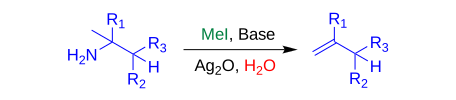
Hofmann elimination is a reaction in which a primary amine undergoes successive alkylation steps followed by treatment with silver oxide, and subsequent E2 elimination to afford an alkene. Unlike Zaitsev’s rule which favours the more substituted alkene, the Hofmann elimination selectively produces the less substituted alkene.
Keywords
Amine, Methyl iodide, Silver oxide, Alkene
Category
Amine
Mechanism
The Hofmann elimination starts with the nucleophilic substitution of iodomethane by the primary amine, yielding an alkylammonium salt. This intermediate is then deprotonated by a base, regenerating a neutral secondary amine. This sequence of nucleophilic substitution followed by deprotonation occurs a second time, producing a tertiary amine. A final alkylation then takes place, leading to a quaternary ammonium iodide salt. At this stage, treatment with silver oxide converts iodide into an insoluble silver iodide precipitate along with a silver alkoxide. This latter is hydrolyzed by water, releasing a hydroxide ion. A concerted E2 elimination then occurs: the hydroxide deprotonates HA while the quaternary ammonium departs simultaneously as a leaving group (LG), affording the alkene product.
Regioselectivity: According to Zaitsev’s ruel, one might expect deprotonation of HB, as it would yield the more substituted and thermodynamically more stable alkene. However, the E2 mechanism requires a strict antiperiplanar geometry between the proton being abstracted and the LG. Analysis of the Newman projections reveals that when HB is placed in an antiperiplanar arrangement relatively to the LG, a significant steric clash arises between the methyl group of N(Me)3 and R3, destabilizing this conformation (illustrated by the projection viewed from the black ball). In contrast, the conformation in which HA is antiperiplanar to the LG (illustrated by the projection viewed from the red ball) presents reduced steric strain. Consequently, HA is selectively deprotonated, affording the less substituted alkene.
Silver oxide treatment: Iodide acts as a nucelophile toward one of the Lewis-acidic silver centres, whose very low solubility drives the reaction and releases the strongly basic AgO- anion. This latter deprotonates a water molecule to give silver hydroxide (AgOH) and a hydroxide ion.
