Hartwig-Buchwald reaction
Abstract
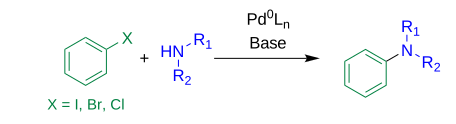
The Hartwig-Buchwald coupling is a palladium-catalyzed reaction used to form new C-N bonds by coupling an amine (primary or secondary) with an aryl halide (Ar-X, where X = I, Br or Cl) in the presence of a base.
Keywords
Amine, Aryl halide, Catalysis, Aniline
Category
Amine, Aromatic
Mechanism
The catalytic cycle begins with the oxidative addition of the aryl halide to the active palladium(0) complex, generating a palladium(II) intermediate (1). This latter then undergoes coordination of the amine, which increases the acidity of the amine proton (2). Subsequent deprotonation by a base (typically sodium tert-butoxide or cesium carbonate) yields a palladium(II) amido intermediate (3). Finally, reductive elimination occurs and affords the arylated amine product while simultaneously regenerating the active palladium(0) catalyst (4).
Competitive pathways: when the amine substrate possesses a hydrogen atom at the β position relative to nitrogen, a competitive β-hydride elimination side reaction can occur from the palladium(II) amide intermediate (A). This step yields a coordinated imine and a palladium(II) hydride species. Subsequently, reductive elimination occurs and gives the undesired aryl product and releases imine by-product (B).
To prevent this side reaction, the use of dialkyl phosphine ligands (XPhos for example) is a good solution. Indeed, these ligands are incredibly bulky and the steric congestion around the palladium center creates immense strain, which drives the complex to undergo rapid reductive elimination

Recent review
Forero-Cotés, P. A.; Haydl, A. M. The 25th anniversary of the Buchwald-Hartwig Amination: Development, Applications, and Outlook. Org. Process Res. Dev. 2019, 23, 1478-1483.