Grignard reaction - Epoxide reactivity
Abstract
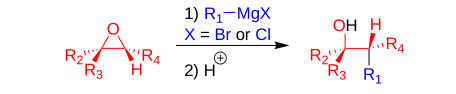
The Grignard reaction is a versatile method for forming new carbon-carbon bonds. It involves a nucleophilic organomagnesium halide reagent, known as Grignard reagent and of a general formula R-MgX where R is an organic group and X is a halogen (either Br or Cl). This reagent acts as a nucleophile in the presence of an epoxide, affording an alcohol.
Keywords
Epoxide, Organomagnesium, Alcohol
Category
Alkane
Mechanism
The reaction begins with nucleophilic attack of the organomagnesium species on the less substituted carbon of the epoxide ring. This attack releases an alkoxide stabilized by coordination to the magnesium halide and appends the organic group R1 to the carbon skeleton. The configuration at the attacked carbon is inverted according to a Walden inversion (SN2 type). Finally, acidic aqueous workup affords the desired alcohol.
