Gattermann-Koch reaction
Abstract
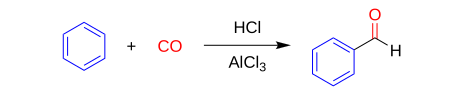
The Gattermann-Koch reaction is an electrophilic aromatic substitution reaction in which an aromatic compound reacts with carbon monoxide and hydrochloric acid in the presence of a Lewis acid, typically aluminium chloride, to give a benzaldehyde.
Keywords
Aromatic, Carbon monoxide, Benzaldehyde
Category
Aromatic
Mechanism
The Gattermann-Koch reaction begins with the combination of carbon monoxide and hydrochloric acid to give formyl chloride (HCOCl). This intermediate is then activated by AlCl3, a Lewis acid: a lone pair on the chlorine atom of formyl chloride coordinates to the aluminium center. The C-Cl bond is then weaker and elimination of tetrachloroaluminate generates the acylium ion. This latter acts as electrophile in an electrophilic aromatic substitution (EAS) of benzene. Attack of the 𝜋 system on the formyl cation gives a Wheland intermediate (arenium ion). Finally, deprotonation of this intermediate releases the desired product. An important feature is that the reaction does not occur when the aromatic reagent contains electron-withdrawing group. Indeed, these latter would decrease the electron density of the aromatic, which disfavours the nucleophilic attack.
