Gabriel amine synthesis
Abstract
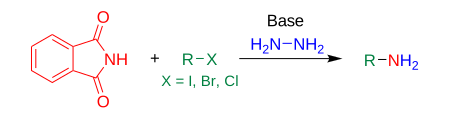
Gabriel synthesis is a useful method for synthesizing primary amines, avoiding the over-alkylation issues typically encountered with direct alkylation. It involves phthalimide, an alkyl halide, hydrazine and a suitable base.
Keywords
Alkane, Alkyl halide, Phthalimide, Amine
Category
Alkane
Mechanism
This reaction starts with the deprotonation of the imide nitrogen of phthalimide by potassium hydride (or another suitable base). This step gives the phthalimide anion, which acts as a nucleophile and reacts with the alkyl halide through a nucleophilic substitution. The resulting N-alkylphthalimide then undergoes nucleophilic acyl substitution with hydrazine, where hydrazine attacks one of the two carbonyl groups, followed by an elimination step. The newly formed intermediate then undergoes an intramolecular nucleophilic acyl substitution, where the second amine of the hydrazine attacks the remaining carbonyl group, releasing the desired primary amine and phthalhydrazide as by-product.
