Fischer indole synthesis
Abstract
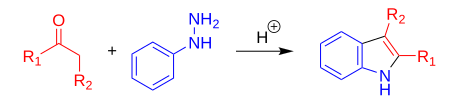
One of the most well-known method to obtain indoles is the Fischer indole synthesis. Under acidic conditions, a carbonyl compound reacts with a phenylhydrazine to obtain the desired indol.
Keywords
Aldehyde, Ketone, Hydrazine, Indole
Category
Aldehyde/Ketone, Hydrazine/Hydrazide
Mechanism
The reaction is performed under acidic conditions and starts with the formation of an imine (Need a refresher? Check the Imine formation sheet). The hydrazone then undergoes tautomerization to give an enamine intermediate. Protonation of this enamine triggers an irreversible [3,3]-sigmatropic rearrangement, which breaks the N-N bond. A new primary amine is obtained after a tautomerization step and attacks the iminium function, leading to intramolecular cyclization. After a prototropy, the elimination of ammonium generates the indole.

Recent review
Heravi, M. M.; Rohani, S.; Zadsirjan, V.; Zahedi, N. Fischer indole synthesis applied to the total synthesis of natural products. RSC Adv. 2017, 7, 52852-52887.