Enolate alkylation
Abstract
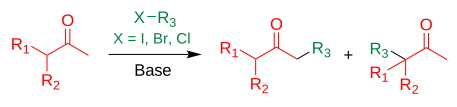
Enolate alkylation is a reaction in which the final product depends critically on the reaction conditions. Using a weak base at room temperature affords the thermodynamic alkylation product. In contrast, a strong base at low temperature results in the formation of the kinetic alkylation product.
Keywords
Aldehyde, Ketone, Alkyl halide, Enolate
Category
Aldehyde/Ketone
Mechanism
Enolate alkylation can proceed via two distinct pathways, leading to different regioisomeric products depending on the reaction conditions.
Thermodynamic pathway: In the presence of a weak base (such as potassium hydroxide) and at or above room temperature, deprotonation occurs preferentially at the most substituted α-carbon, yielding the most stable enolate. This latter then undergoes nucleophilic substitution with an alkyl halide (R3-X, where X = I, Br or Cl), affording the thermodynamic alkylation product.
Kinetic pathway: In the presence of a strong, hindered, non nucleophilic base such as lithium diisopropylamide (LDA), at low temperature (-78 °C), deprotonation occurs selectively at the less substituted α-carbon, giving the kinetically favored enolate. This intermediate subsequently reacts with an alkyl halide through a SN2 substitution, affording the kinetic alkylation product.
