Dieckmann condensation
Abstract
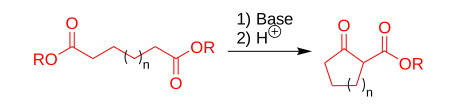
Dieckmann condensation is an intramolecular reaction between a diester and a base, leading to a cyclic β-keto ester.
Keywords
Diester, Carbonyl, Cyclic β-keto ester
Category
Ester
Mechanism
A strong base first deprotonates the α-hydrogen of an ester to generate an enolate. This latter then performs an intramolecular nucleophilic attack to the carbonyl carbon of the second ester group within the same molecule forming a cyclic tetrahedral intermediate. The departure of the alkoxide group produces a cyclic β-keto ester. The hydrogen located between the two carbonyl is highly acidic and thus easily deprotonated by the base to form a stabilized enolate. Finally, acidic workup reprotonates the enolate to give the neutral cyclic β-keto ester.
If R1 and R2 are different, the overall reactivity and regiochemical outcome are governed by a few factors working together: First, the reaction is driven to completion by irreversible deprotonation of the β-keto ester product, so the favored pathway is the one giving the product whose remaining α-hydrogen is most acidic. Second, enolate formation occurs preferentially at the less hindered α-carbon. Third, among the geometrically possible combinations of nucleophilic enolate and electrophilic ester carbonyl, the one leading to a favored 5- or 6-membered ring predominates over alternatives that would give strained or unfavorably sized rings.

Recent review
De, S. K. Applied Organic Chemistry: Reaction Mechanisms and Experimental Procedures in Medicinal Chemistry; John Wiley & Sons: Hoboken, NJ, 2020.