Corriu-Tamao-Kumada coupling
Abstract
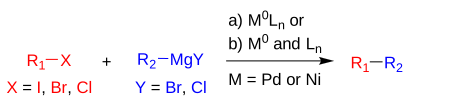
The Corriu-Tamao-Kumada coupling is a palladium or nickel catalyzed reaction, where an organic halide (aryl, vinyl or alkyle halide) (R1-X, where X = I, Br or Cl) reacts with a Grignard reagent (R2-MgY, where Y = Br or Cl) to create a new C-C bond.
Keywords
Alkyl halide, Vinyl halide, Aryl halide, Organomagnesium, Cross-coupling
Category
Organometallic catalysis
Mechanism
The reaction starts with the oxidative addition of the alkyl, aryl or vinyl halide to the metal catalyst (palladium or nickel historically), oxidizing it from M(0) to M(II) (1). Then, the Grignard reagent transfers its organic group to the metal center while the magnesium coordinates the halide through a transmetallation step (2). Finally, reductive elimination releases the desired coupled product and regenerates the active M(0) catalyst species (3).
