Claisen condensation
Abstract
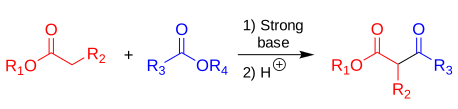
The Claisen condensation is a carbon-carbon bond forming reaction in which two esters (or one ester and a carbonyl) react in the presence of a strong base such as alkoxide or aminide to form a β-keto ester.
Keywords
Ester, Condensation, C-C bond formation, β-keto ester
Category
Ester
Mechanism
First, the base removes an hydrogen atom in α-position relative to the ester to form an ester enolate. This enolate acts as a nucleophile and attacks the carbonyl of another ester, leading to the formation of a tetrahedral intermediate. The intermediate then eliminates an alkoxide, generating a β-keto ester. It is important to note that the proton between the two carbonyl groups is more acidic than that of the starting esters, which leads to the formation of the corresponding enolate due to the excess of strong base used during the reaction. An acidic workup at the end of the synthesis enables the recovery of the desired β-keto ester.

Recent review
Khademi, Z.; Heravi, M, M. Applications of Claisen condensations in total synthesis of natural products. An old reaction, a new perspective.Tetrahedron. 2022, 103, 132573.