Carboxylic acid activation - Anhydride
Abstract
Carboxylic acids are poor electrophiles in their native form due to the resonance delocalization of the carboxylate that reduces the electrophilicity of the carbonyl carbon. Activation consists of converting the -OH into a better leaving group, generating a more reactive acyl electrophile toward nucleophiles (amines, alcohols, organometallics, etc…). Beyond the existing methods to activate a carboxylic acid, one consists in converting it into an anhydride, highly reactive toward nucleophilic attack.
Keywords
Carboxylic acid, Activation, Anhydride
Category
Carboxylic acid
Mechanism
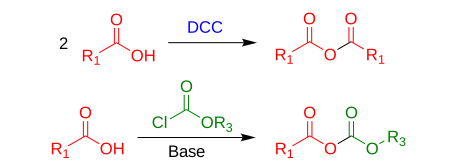
Anhydrides can be either symmetric or asymmetric (mixed anhydride). For symmetric anhydride synthesis, two equivalents of a carboxylic acid are coupled using 1 equivalent of a coupling reagent such as DCC (dicyclohexylcarbodiimide). Mechanistically, one equivalent of carboxylic acid is first activated by a carbodiimide (typically, DCC), forming an O-acylisourea intermediate (active ester). The second equivalent of the carboxylic acid, in its carboxylate form, then attacks the activated carbonyl carbon, yielding the symmetric anhydride.
The use of HOBt as additive is recommended to avoid racemization when there is a stereocenter in the α-position of the carboxylic acid. For mixed anhydride synthesis, a carboxylic acid is coupled to a chloroformate. In this case, the leaving group is a carbonate ion. Because the carbonate carbonyl is significantly less electrophilic than the acyl carbonyl, subsequent nucleophilic attack occurs preferentially at the acyl carbonyl center.
