Biginelli reaction
Abstract
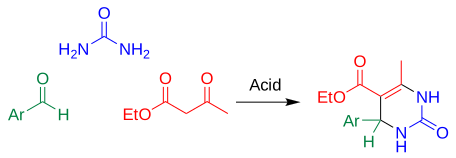
The Biginelli reaction is a multicomponent condensation where the final product 3,4-dihydropyrimidin-2(1H)-one is obtained through a sequence of bimolecular steps involving an aryl aldehyde, urea and a β-keto-ester. The reaction proceeds under the catalysis of either a Brønsted or Lewis acid.
Keywords
Aryl Aldehyde, Urea, β-keto ester, Heterocycle
Category
Multicomponent reaction
Mechanism
The reaction begins with the activation of the aryl aldehyde by a Brønsted acid, facilitating the nucleophilic addition of urea. The intermediate undergoes a proton transfer where the ammonium group transfers a proton to the hydroxyl function. Subsequent elimination of water leads to the formation of an iminium intermediate. The β-keto-ester then performs a nucleophilic attack on the iminium carbon. The resulting intermediate undergoes cyclization through the nucleophilic addition of the free amine to the protonated carbonyl group. A further proton transfer step is followed by an elimination of water. Finally, the Brønsted acid is regenerated with the deprotonation of the α-proton of the ester group and the 3,4-dihydropyrimidin-2(1H)-one is formed.
